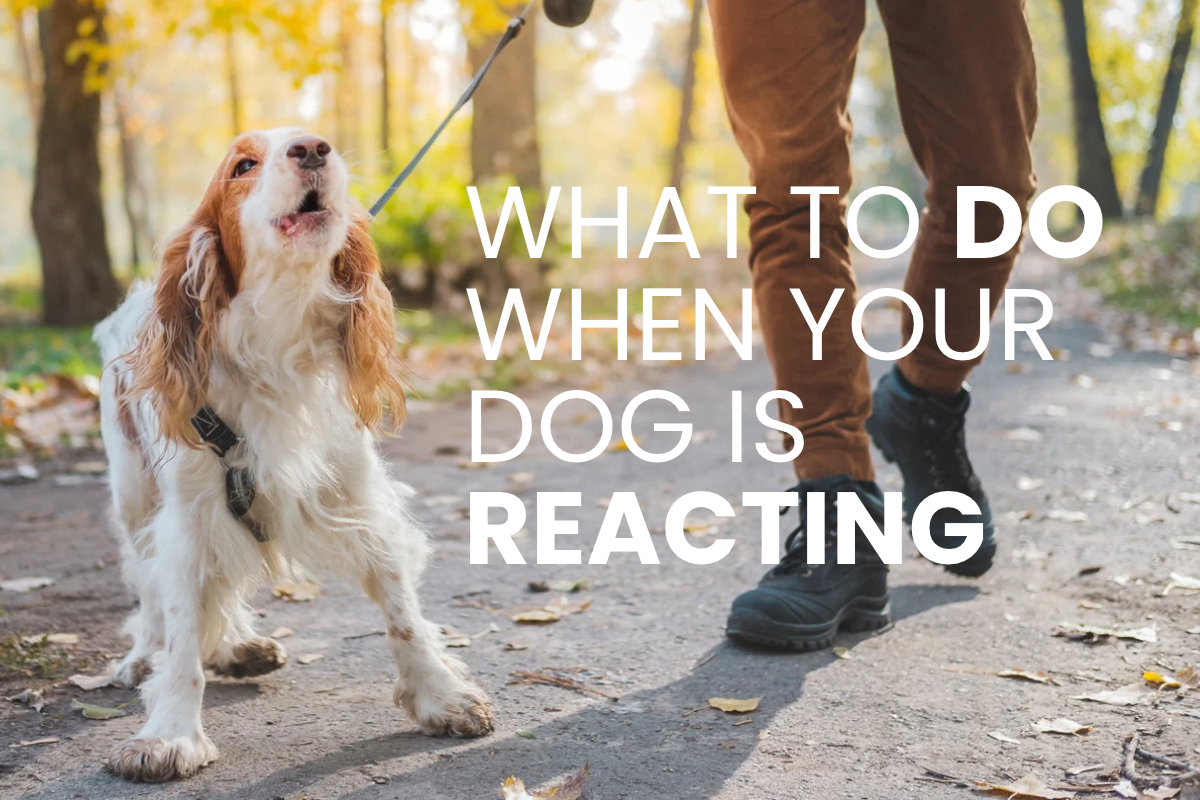
You did everything right. You picked a quiet route, packed the good treats, and kept an eye on your dog’s body language…and then a dog came around the corner, and suddenly you’re holding the leash of a barking, lunging, spinning tornado. Despite the best-laid plans, some reactions simply can’t be avoided - but you do have options for helping your dog during these events.
Throughout the process, be kind to yourself. Living with a reactive dog can be hard, and the fact that you are reading a three-part blog series about it says a lot about how much you care.
Reactions as information
Progress with reactivity, or any type of behavior modification, is almost never linear. What matters is the overall trend over weeks and months, not any single outing. Rather than being hard on yourself when a reaction happens, try to treat it as useful information. What was different about today? Was your dog already stressed, was the trigger closer than usual, or did it come as a surprise? Those observations can help you and your trainer adjust the plan going forward.
Damage mitigation, not a training moment
As discussed in Part 1: Understanding Your Reactive Dog’s Threshold, a dog who is reacting has crossed their “behavior threshold,” and their cognitive capacity at that moment is significantly diminished. It’s not a teaching moment; it’s a damage mitigation moment.
The real training happens before and after a reaction: in the hundreds of easy, successful repetitions you practice when your dog is relatively calm, and in the management that prevents reactions from happening in the first place (see Part 2: Easy Ways to Reduce Reactions). During a reaction, the best thing you can do is help your dog get out of it as quickly as possible.
What to do when your dog is reacting
Every dog and every situation is a little different, but the following steps can help you end a reaction and set your dog up to recover:
Take a breath: Your dog is paying attention to you, even when it doesn’t seem like it. A tight leash, sudden movements, or a raised voice can add to the intensity of the moment. Take a slow breath and try to keep yourself calm. (Easier said than done, we know!)
Create distance: Distance is your best friend. Calmly turn and move away from the trigger, ideally in a direction you planned ahead of time. Even a few additional feet of distance can lower the intensity enough for your dog to become more receptive to cues from you.
Keep the leash as loose as you safely can: Holding your dog back on a short leash can add pressure and frustration. Hold the leash securely and keep your arms in close to your body to help you maintain a strong center of gravity. Avoid pulling, jerking, or swinging your dog around. If you need to move your dog, use your body and your movement to guide them rather than choking up on the leash. The leash will likely still be tight, but your dog will have the option to create slack in the leash the instant they yield to the leash pressure and begin moving with you.
Use a barrier: If available, step behind a parked car, a tree, or around a corner to break your dog’s line of sight. Many dogs settle much more quickly once the trigger is out of view.
Use your well-rehearsed exit behaviors: An Emergency U-Turn or a Find It can help interrupt the reaction and give your dog something to do besides bark. (More on these below.)
Keep cues simple and don’t repeat them: Your dog may not be able to respond right away. Rather than repeating a cue over and over while your dog continues to react, focus on moving away and making it easy for them to follow you.
Offer food, but don’t worry if they won’t take it: Some dogs will follow a food lure even during a reaction if it is put right on their nose. If your dog can do that, use it to your advantage. If your dog refuses even their favorite treats, that’s a sign they are over threshold and you need more distance. Keep moving away, and offer again once you have more space. When your dog starts eating again, it’s a good sign you are approaching a safer distance.
Let them shake it off: Once you have some distance, give your dog a moment. Many dogs will shake off, sniff the ground, or take a few deep breaths as they recover. Let them do this rather than rushing straight into the rest of your walk. A food scatter in the grass can help.
Cut the outing short if needed: If your dog is having a hard time recovering, it’s okay to head home. A short, quiet sniffari or a calm evening at home is often better than pushing on and risking another reaction.
Afterward, plan for some decompression time. As we discussed in Part 2, a quiet day or two at home after a reaction can help your dog’s stress levels come back down and give them the bandwidth they need to be successful on their next outing.
How well-rehearsed exercises can help
One of the most effective tools you can have in your back pocket is a behavior your dog knows so well that they can do it even when they are stressed. Think of it as a fire drill for your dog. The more often a behavior has been practiced in easy situations, the more automatic it becomes, and the more likely your dog will be able to perform it even under pressure. Just like a golfer practices their swing thousands of times at a driving range before competing in a tournament, your dog needs to practice a lot behind the scenes. Behaviors that involve changing direction or taking food tend to work especially well, because they help your dog move away from the trigger and give them something to focus on.
A few of our favorite exit behaviors include:
Find It and food scatters: Say “Find it!” and then scatter a few small, high-value treats on the ground in front of your dog. Sniffing and searching is naturally calming for many dogs, and it moves their eyes off the trigger and onto the ground. Practice a lot at home on blankets or snuffle mats, then in the yard and on walks when there are no triggers around. When a trigger appears, you can repeat Find It each time your dog lifts their head to watch, until the trigger has passed or your dog has begun to relax. Eating in stressful situations is a skill that can be built over time.
The Emergency U-Turn: Teach a quick turn in the opposite direction, rewarding your dog for following you. Practice at home first, then several times on every walk when there are no triggers around, so the U-Turn becomes a fun, familiar game. Play around with your speed and the distance your dog must follow you after the turn before earning the reward.
Emergency recall: A special recall word that is always followed by an amazing reward can be a lifesaver when you need to get your dog’s attention quickly. Condition it with a variety of high-value foods and build up the difficulty gradually as your dog shows they can be successful.
The key is to practice these behaviors often, in situations that are easy for your dog to get right. If the first time your dog hears “Find it!” is while a dog is barking at them from across the street, it is unlikely to work. If they have done it hundreds of times in the living room, the backyard, and on quiet walks, it has a much better chance of being successful. We are building an automatic, muscle-memory-driven response that doesn’t require any higher thinking.
What not to do, and why
When your dog is barking and lunging in public, it’s completely understandable to feel embarrassed, frustrated, or even angry. But we never recommend punishing, scolding, or getting mad at a dog for reacting.
Remember that your dog is over threshold. Their brain is in red alert mode, not learning mode, so a “correction" in that moment isn’t teaching them anything useful. What it does do is add more stress to a dog who is already overwhelmed. Yelling, leash pops, or other forms of punishment can make the reaction more intense and make it harder for your dog to come back down. Your dog has very little control over their reactions; no more so than an arachnophobic person has over their response when they see a spider. Punishing them isn’t fair or effective.
Punishment can even backfire in the long run. Your dog’s underlying emotions are what drive the outward symptoms of barking and lunging. If every time another dog appears, your dog also experiences something unpleasant from you, they may perceive through Pavlovian conditioning that other dogs predict bad things happening, which can make them feel even worse about seeing dogs.
Enjoyable outings are possible
Over time, as your dog builds new skills and has more positive experiences, you’ll likely notice that reactions become less intense and less frequent, and that your dog bounces back more quickly when they do happen. These are all signs of real progress, even if the road to get there has a few bumps along the way.
You don’t have to navigate this alone. Our team is here to help you and your dog build the skills and confidence you need to enjoy the world together.
Ready to dig in? Schedule a private lesson with one of our experienced trainers.