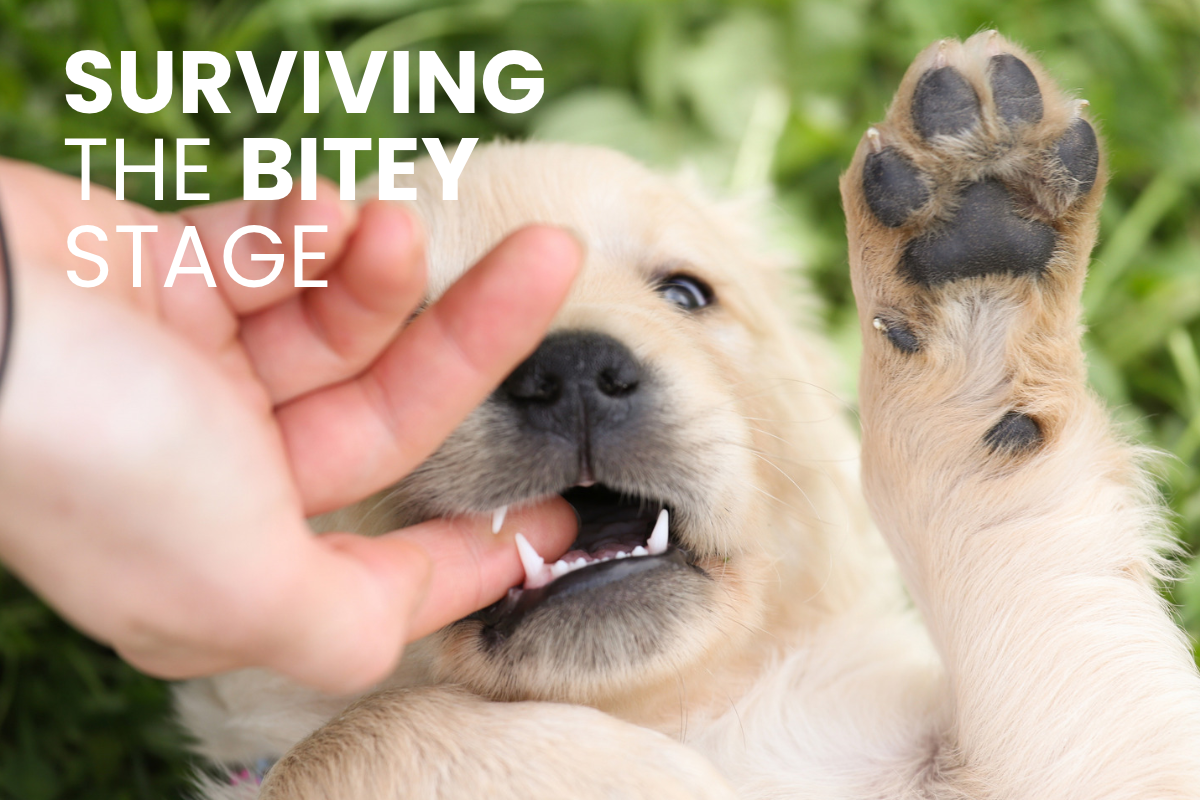
Puppies explore the world much like human babies do: by getting into everything. But while babies have hands to grab, touch, and investigate objects, puppies must rely primarily on their mouths. Beyond a tool for discovery, puppies also use their mouths to communicate, play, and initiate social interactions.
The good news is that puppy biting is a normal developmental stage. With time, maturity, and thoughtful training, it will improve. The less-good news is that mouthing and nipping are a developmental stage, and likely to be part of life with your puppy for the first few months.
A puppy who mouths your hands during a greeting is often just trying to interact using the tools they have. Our job is to teach them more appropriate ways to say hello while anticipating their needs and setting them up for success.
Start with management
A good management plan is essential for surviving puppyhood with your hands, clothes, and home intact. Management is helpful when your puppy is too excited, tired, or distracted to make the choices you want them to. It also plays an important role in addressing potty training and unwanted chewing (which we’ll discuss in more detail in future posts).
Exercise pens and baby gates are two of your best tools. They create a safe space for your puppy while giving you the ability to step away when you need a break, and they can be used for puppies who aren't fully crate trained yet.
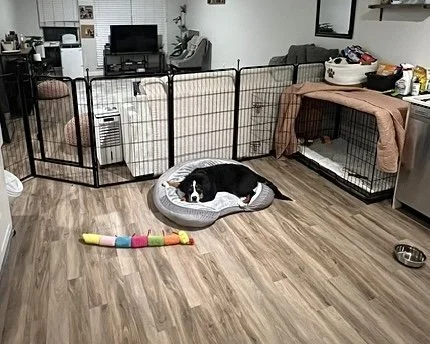
Scout the Bernese Mountain Dog puppy resting in a strategically gated-off kitchen
Set up a puppy-proofed area with:
Fresh water
A comfortable place to nap
Appropriate toys and chew items
Enough space to move around safely
You can place your puppy in this area when they need some downtime, or simply step to the other side of the gate when you sense a biting spree brewing.
Confinement should not be used as a punishment. The pen is a safe environment where the puppy can relax, enjoy appropriate activities, and is prevented from practicing unwanted behaviors.
Ready to dig in? Join a Kinship Puppy Class in North Bend for hands-on help with puppy nipping.
Provide Appropriate Outlets
Biting and chewing are biological needs for puppies (and dogs of all ages). The goal isn't to eliminate these behaviors entirely, but to teach your puppy what is appropriate to put their mouth on.
Experiment with different toys, materials, and textures to discover what your puppy enjoys. Some options include:
Long-lasting chews, such as bully sticks secured in an appropriate “bully holder”
Stuffed Kongs or Toppls filled with food
Rubber toys designed for chewing
Soft or textured toys that your puppy can safely gnaw on
Puppy chewing a bully stick in safe bully holder
Always supervise your puppy with toys and chews. Anything they can tear apart and swallow may present a choking or intestinal obstruction risk. Choose items appropriate for your puppy's size and chewing style, and replace damaged toys. The Kong you choose should be too large for your puppy to fit entirely in their mouth.
Make meals work for you
One of my favorite strategies is to use food-dispensing toys instead of serving every meal in a bowl.
When I hosted puppy board-and-trains during pandemic lockdown, I kept my refrigerator full of pre-stuffed Kongs and Toppls. I'd divide the puppy's daily food allowance among several toys, mixing kibble with a little something extra tasty and sticky. Getting every last bit out required licking, chewing, and working at the toy.
This served several purposes: it gave the puppies an appropriate outlet for their mouths, provided mental enrichment, and often helped them settle down for a nap or relax during confinement.
Some food mix-ins to try include:
Wet canned food from the same brand as your puppy's regular kibble
Mashed sweet potato
Peanut butter or other nut butter (check carefully for xylitol, which is toxic to dogs)
Plain, unsweetened yogurt
Cottage cheese
Mashed banana
Canned tuna
Meat-flavored baby food (check the ingredients for unsafe additions, such as onion or garlic)
Dog-safe squeezable treats, such as Churu
Use small amounts of extras, account for them in your puppy's daily food intake, and introduce new foods gradually. A small spoonful of canned 100% pumpkin can help regulate tummies.
If your puppy is new to food dispensing toys, start easy. If the difficulty level is too hard, some puppies will give up quickly. You can use dry kibble in a Kong, or loosely piled wet food in an open-faced Toppl. Some puppies might need you to push the toy around and give them some encouragement to get them started. Toppls can be a nice first food-dispensing toy that is more accessible, and often less frustrating, than a Kong.
Recognize trouble brewing
Pay attention to what happens immediately before your puppy gets mouthy. Common precursors include:
Movement: Walking across the room, flapping clothing, and waving hands or feet can activate a puppy's natural chase and grab instincts. Moving body parts are particularly exciting targets.
Unmet biological needs: Puppies who are hungry, thirsty, need to potty, or are tired may become especially nippy. Just as a baby might cry when they have a need, a puppy may communicate through increased mouthing.
Attention-seeking: Puppies quickly discover that putting their teeth on people gets a reaction. Even negative attention can be rewarding if what they wanted was interaction.
Play and exploration: Puppies use their mouths to investigate their surroundings, manipulate objects, and interact with people and other animals.
Teething: As adult teeth come in, puppies experience changes and discomfort in their mouths. Chewing can help relieve those sensations, and biting may temporarily become more intense during certain stages of teething.
You might see body language changes when your puppy is about to get nippy, such as:
Speeding up: The puppy might become more frenetic in their movements or get “the zoomies.” They may whip their head around more or look like they want to chase. They may start to bound or sprint instead of trotting around with floppy paws.
Harder mouth: You might notice the puppy taking treats with more pronounced tooth contact instead of the soft mouth they were using a moment ago.
Vocalizing: A puppy who is revving up to a nipping spree might vocalize more, including yipping, whining, barking, or “talking.”
Inability to focus on training: The puppy may have trouble staying engaged, and might become more interested in shoes or clothing than in following along with the lesson. This is also a time to check whether they need a potty break.
Changes in play: The puppy might start to ignore a toy, opting to to go around it to get at hands. Conversely, you may see the puppy become grabbier with the toy, exhibiting exaggerated or quick chomping.
Dilated pupils: As puppies and dogs get more worked up, sometimes their pupils will expand.
Half-moon eyes: Your puppy’s eyes may become wider and you might see more whites of the eye than when your puppy is calm.
Panting: The puppy may start to pant more, which can be a sign of excitement or stress.
Not all puppy biting looks the same
Sometimes your puppy will mouth your hands relatively gently during interactions. Other times, they'll transform into a tiny velociraptor (and nothing but human flesh will satisfy them).
In baby velociraptor mode, it can be difficult to get your puppy to redirect to a toy, participate in a training session, or respond to any of the cues you’ve been working on. These witching hours tend to occur after certain types of activities or at certain times of day, such as in the evenings around dinner time.
Once your puppy’s witching hour has begun, their ability to respond or regulate themselves is severely limited. The puppy has become like a toddler having a meltdown (a creature that can’t easily be reasoned with). Learning to identify the precursors to your puppy’s more extreme episodes means you can redirect or use the management you’ve put in place before the puppy has latched on and won’t let go.
Prevention is the best medicine, but if your puppy suddenly becomes a whirlwind of teeth, consider whether they're overtired or have another unmet need.
Check that they've recently:
Gone potty
Had food and water
Enjoyed some appropriate play, exploration, or training
If those needs have been met, rest is often the answer. A stuffed Kong, a comfortable resting space, and some quiet time may be what your puppy needs.
Need help with terrible toothy meltdowns? Schedule a personalized private lesson in your home.
Reward the behavior you want to see
It's easy to overlook a puppy when they're being calm and quiet. Sometimes those peaceful moments are precious! But if the puppy only gets attention when they're biting, jumping, or being rowdy, we may inadvertently teach them that those behaviors are the best way to get us involved.
Look for opportunities to reward the choices you like.
For example, when your puppy:
Approaches you without putting their teeth on you
Sits instead of jumping
Looks at you to initiate interaction
Picks up an appropriate toy
Settles quietly nearby
Respond with attention, praise, play, or treats.
These moments teach your puppy that they don't need to use their teeth to get good things to happen.
You can also get ahead of predictable biting by offering an appropriate activity before your puppy has a chance to grab you. For example, I sometimes carry a long tug toy and drag it along the ground when I need to walk through an already-alert puppy's space. The puppy's natural instinct to chase and grab gets redirected onto the toy rather than my pant leg.
What to Do When Your Puppy is Nipping
When nipping happens, your response will depend on how excited your puppy is.
For mild mouthing
Start by slowing down. If your puppy is lightly mouthing you, try standing still and calmly pausing your interaction. You can also make a gentle kissy noise to get their attention or ask for a familiar cue, such as Sit.
If your puppy responds, praise them and resume interaction. You can also introduce a toy for a gentle game or redirect them into a short training session with treats.
Avoid jerking your hands away, flailing, or frantically backing up. These movements can make the interaction more exciting and encourage your puppy to chase and grab even more. Pulling away can also cause teeth to rip skin.
If the biting continues
If your puppy keeps nipping, calmly remove access to yourself. Step behind a baby gate or onto a couch where they can't reach you. In some cases, you may need to gently pry your puppy’s mouth open to extract your sleeve or arm.
Once your puppy is calm enough to sit or stand without jumping and grabbing, offer attention again.
You may need to repeat this process several times before your puppy starts connecting the dots: biting makes the fun person disappear, while calm behavior makes interaction possible.
If your puppy becomes increasingly frustrated or can't seem to settle, stop trying to train through the episode. Check that their basic needs have been met, then offer a stuffed food toy or appropriate chew and help them settle in their pen.
Train alternative behaviors
It may feel like biting happens constantly, but you'll often discover that certain activities or transitions are responsible for a large portion of it. When you can anticipate when nipping is likely, you can form a proactive training plan.
Common examples include:
Putting on a leash or harness
Petting, especially reaching over the puppy's head
Morning greetings and other transitions
People getting up and moving after sitting still
People arriving home or visiting
Children running or playing energetically
Dangling leashes, especially when the puppy is already excited
Each of these situations is an opportunity to teach a more appropriate response.
Dogs are excellent at recognizing patterns. We can use that to our advantage by building simple routines that help the puppy practice the picture we prefer.
Example: Sitting and lying down pay well
Before the puppy can be expected to ask for attention in a way humans consider polite, we need to show them what that looks like. What DO we want them to do? Teach your puppy about Sit and Down, and reward handsomely for these behaviors. Do short (one to two minute) sessions every day, and your puppy will have a foundation for asking for the things they want without using their teeth. If you have started working on Sit and Down, you may have already noticed your puppy offering these behaviors unprompted. That’s great! Help them perform the Sit or Down before gaining access to things they like, such as attention, access to outside (when it’s not a potty emergency), the start of a toy game with you, a long-lasting chew, etc.
This should be a proactive process. Your “Sit” cue might eventually help snap your puppy out of mouthing, but not if they have never been introduced to the concept. Train at opportune times, before your puppy has started nipping.
Example: Putting on the leash
If your puppy grabs the leash while you're trying to attach it, change the routine. Hold the leash in one hand and feed your puppy a treat with the other as you clip it on.
Repeat this pattern consistently. Your puppy learns that the leash coming out predicts something good, and that keeping their mouth off the leash is part of the process. You can do this in the moment when you actually need to put the leash on, but you can also practice at other times as a fun training session, clipping the leash on and off several times so your puppy can get the benefit of multiple reps. This also makes the leash a less exciting event, because it isn’t only appearing right before a walk or car ride.
With practice, the routine will become so automatic that you no longer need to use treats every time.
Example: Teaching polite responses to petting
You can use a similar process for a puppy who grabs hands during petting.
Start with treats in one hand:
Feed your puppy a treat while reaching out and petting them with your other hand.
Repeat until your puppy is consistently taking the treat instead of trying to bite the petting hand.
Once your puppy understands the pattern, briefly touch them before delivering the treat.
Repeat a few times.
Gradually increase the duration of petting before rewarding.
Keep these sessions short, positive, and easy for your puppy. If they start mouthing or become uncomfortable, make the exercise easier.
You can use the same approach to introduce handling of the ears, paws, mouth, and other body parts that may need regular attention for grooming or veterinary care.
Over time, you can teach your puppy that human hands approaching their body is a cue to be calm, not an invitation to wrestle.
Plan for visitors
Puppies can be especially excited when someone new arrives. Brief your guests on your training plan before they come over. It's much easier than trying to explain things while your puppy is jumping for joy and your visitor is distracted by puppy cuteness!
Ask guests to avoid rewarding jumping, mouthing, or barking with attention. This may mean playing the "Invisible Puppy Game" for the first few minutes after arrival:
No reaching toward the puppy
No excited, high-pitched greetings
No petting while the puppy is jumping or grabbing
Reassure your guests that they'll get their chance to say hello once the puppy is calmer.
Decide ahead of time how you'll manage your puppy's arrival routine. Options include:
Keeping the puppy behind a baby gate with a delicious stuffed Kong
Having the puppy on leash and rewarding calm behavior with treats
Using a crate or separate room for a quiet introduction period
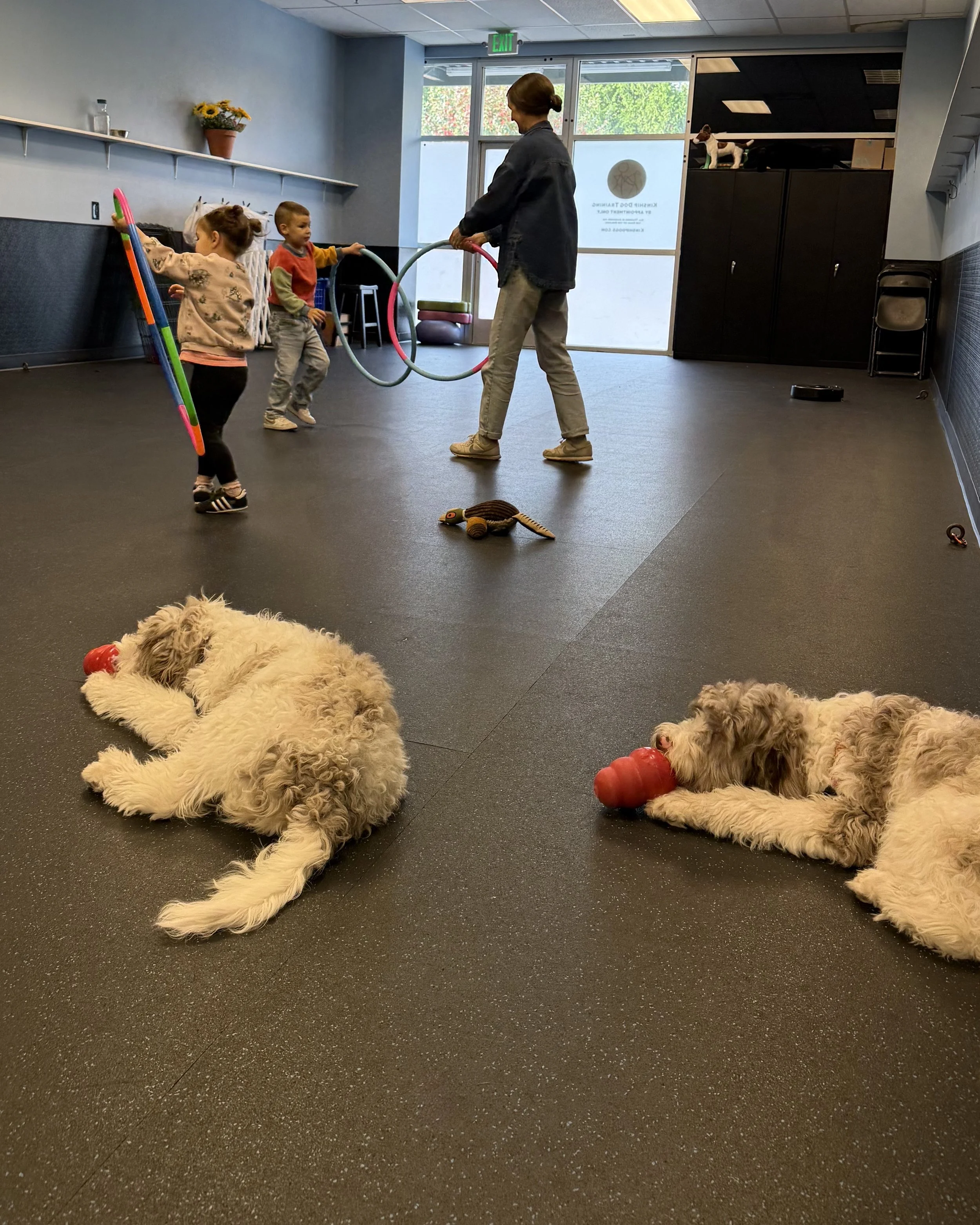
With the help of stuffed kongs and a few minutes on leash, these puppies were able to settle off-leash around young children doing exciting things.
Most puppies need a few minutes to work through the excitement of a visitor arriving. After five to ten minutes, they may be better able to sit, settle, or interact without using their teeth.
Once your puppy is calm enough to greet the guest, you can opt to let them interact. This helps teach the puppy that calm behavior is what makes gains access to fun new friends. You can continue to reinforce your puppy for good choices, give them directions, and use the leash to curb overly excited behavior when necessary.
When to get professional help
Puppy mouthing is normal, but that doesn't mean you have to simply tolerate every behavior or wait for your puppy to grow out of it.
Persistent biting can become painful, frustrating, and even frightening, particularly with larger or more athletic puppies who can easily reach sensitive areas such as upper arms and faces.
Simply ignoring the behavior usually isn’t enough, and reacting with frustration or excitement can sometimes make things worse.
Join us in Puppy Class to learn more strategies for curbing typical puppy biting.
If your puppy is biting especially hard, seems to guard food or objects, suddenly develops a significant change in biting behavior, or you’re having trouble managing the biting around small children or guests, consider scheduling a private lesson. A qualified professional can help you understand what's driving the behavior and develop an appropriate plan.
Ready to dig in? Join a Kinship Puppy Class in North Bend for hands-on help with puppy nipping.
Puppy not ready for class? Schedule a personalized private lesson in your home.